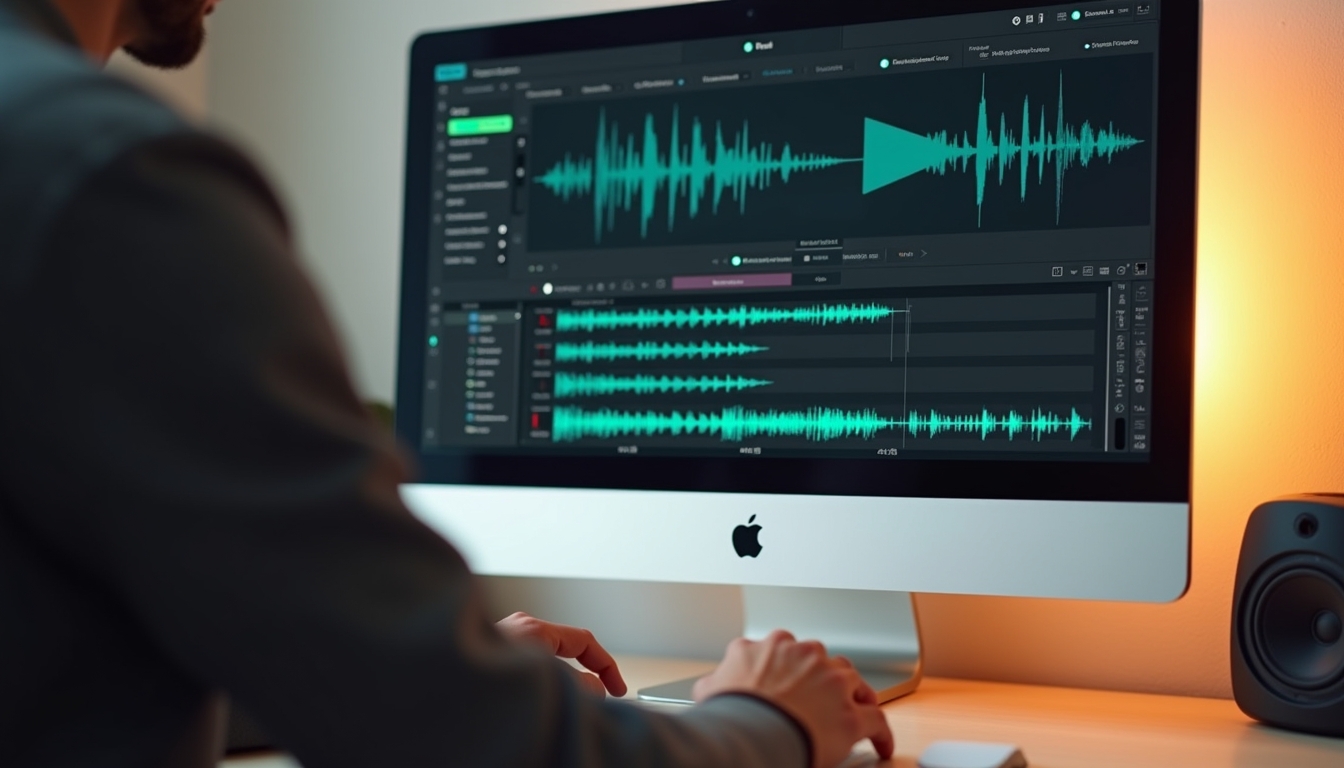
Audio Editing AI: Transforming Your Soundscape
The Rise of AI in Audio Editing
Overview of AI-Driven Technologies in Audio
The realm of audio editing AI is expanding rapidly, ushering in an era where traditional sound editing meets the prowess of artificial intelligence. By integrating this technology, audio professionals can now leverage machine learning in audio, enhancing the detail and efficiency in their projects. Today’s AI solutions are capable of not only improving sound quality but also automating tasks that once required manual oversight. As we step into an age dominated by digital soundscapes, AI-driven innovations are playing a pivotal role in reshaping how we understand and manipulate audio.
Recent advancements reveal a fascinating trajectory in AI applications within audio editing, driven by significant improvements in deep learning algorithms. A prominent trend involves incorporating features such as neural network-based noise reduction and intelligent sound enhancement. These technologies are laying the groundwork for more intuitive and user-friendly interfaces, enabling unprecedented creativity and precision in audio content production.
As the technology evolves, we can anticipate more sophisticated tools on the horizon that promise to further integrate AI with human creativity, leading to dynamic changes across industries reliant on audio technology.
Step-Audio-EditX: A Game Changer
Step-Audio-EditX, developed by StepFun AI, emerges as a leader in the audio editing landscape, leveraging a cutting-edge framework with 3 billion parameters to redefine expressive speech editing. This model treats audio edits akin to text edits, providing unparalleled control over emotion and tone through sophisticated open-source TTS (text-to-speech) capabilities. The integration of expressive speech editing as text editing is not only innovative but transformative, allowing sound engineers to manipulate audio with the precision previously reserved for textual editing.
An intriguing aspect of Step-Audio-EditX is its dual codebook tokenizer and the employment of large margin learning from synthetic data, elements which significantly enhance the emotional and stylistic accuracy of audio edits. As demonstrated by StepFun AI’s release notes, emotion accuracy leaps from 57.0 to 77.7 at iteration three, showcasing the model’s efficiency (source).
Moving forward, such technologies are set to continue revolutionizing audio editing, offering more refined and human-like speech synthesis capabilities that promise to transform auditory experience across multiple platforms.
How Step-Audio-EditX Enhances Expressive Speech
Unpacking Emotion and Style Control
Step-Audio-EditX marks a significant milestone in audio editing by enriching expressive speech capabilities. At its core, the technology leverages advanced paralinguistic features, improving emotional accuracy in audio outputs. By allowing fine-tuned speaking style adjustments, the tool achieves a nuanced control over the delivery and emotive content of speech. For instance, paralinguistic editing accuracy rises impressively, as data indicates an improvement from a score of 1.91 to 2.89 per single edit iteration (source).
The capacity to manage a broad spectrum of emotional expressions presents a myriad of opportunities for content creators, artists, and educators alike. By refining how emotion and style are conveyed, AI technologies like Step-Audio-EditX empower professionals to deliver content that resonates more authentically with audiences.
Looking ahead, the capability to seamlessly integrate and control emotion and style in digital communication could lead to groundbreaking developments in fields such as virtual reality, entertainment, and beyond.
Dual Codebook Tokenizer and Learning Advances
Step-Audio-EditX showcases the power of its dual codebook tokenizer, a technological advancement that contributes to the system’s sophisticated functionality. This approach enables enhanced tokenization of complex speech patterns, facilitating more accurate synthesis even from synthetic sound data. Additionally, large margin learning techniques enable the model to learn and adapt effectively, outperforming traditional editing strategies notably.
The contrast between AI-powered and conventional editing is stark; while the latter often struggles with consistency and quality in mimicry, AI offers a scalable solution with notable improvements in authenticity and realism. These advancements not only bridge the gap between artificial and genuine expressions but also open doors for future enhancements in LLM audio models.
With ongoing research and development, we can expect these capabilities to further refine, delivering increasingly natural and convincing vocal performances for various applications.
The Impact of LLM Audio Models
Understanding LLM in Audio Processing
Long-form language models (LLMs) have transitioned beyond text to revolutionize audio processing, providing robust frameworks for creating high-quality audio edits. LLM audio models utilize vast datasets to predict and generate speech outputs with remarkable precision. Their application spans audio translation, transcription, and enhanced sound quality adjustments, illustrating their versatility in the audio editing domain.
With the capability to manage intricate nuances and contextual details, LLMs deliver unparalleled precision in audio manipulation. Their contribution to achieving seamless, high-quality edits reinforces the role of AI in tackling complex audio tasks that were once labor-intensive and prone to error.
As these models continue to evolve, their potential to redefine audio content creation is immense, hinting at a future where more personalized and immersive auditory experiences are commonplace.
Future Directions for Open Source Audio Tools
The growth of open-source audio tools is poised to reshape the landscape of audio technology, offering exciting prospects for democratizing audio editing capabilities. By encouraging community collaboration and contribution, developers can overcome challenges and innovate beyond existing limitations. This collaborative ecosystem is instrumental in advancing tools like Step-Audio-EditX and propelling the industry to new heights.
While open-source models present numerous opportunities, they also face obstacles such as maintenance, funding, and ensuring user-friendly interfaces. However, as the open-source community expands, these challenges are surmountable, promising a future where audio engineers and hobbyists alike can access cutting-edge open-source TTS technologies.
Anticipating continued innovation, open-source development will likely catalyze a new wave of breakthroughs, fostering a creative and flexible environment for audio advancement.
Machine Learning in Audio: Toward the Next Frontier
Current Applications in Industry
Machine learning’s integration into audio has unlocked new layers of innovation and functionality across industries. Notably, companies harness these technologies for tasks ranging from real-time sound analysis to personalized audio recommendations. Examples abound, showcasing how machine learning applications in audio have transformed broadcast media, music production, and more.
Case studies highlight successful integrations, such as how radio stations optimize playlist curation using machine learning algorithms, enhancing listener engagement and satisfaction. Such implementations underscore the transformative impact of AI-driven audio technologies on conventional media paradigms.
As the technological landscape evolves, we anticipate machine learning driving further advancements, influencing everything from smart assistant experiences to fully interactive audio-visual systems.
Ethical Considerations and Oversight
As audio editing AI advances, addressing ethical considerations becomes imperative. The use of automated tools necessitates careful oversight to mitigate the risk of dependency on AI solutions that may not always interpret context accurately. Ensuring human review remains an integral part of the audio workflow is essential to uphold quality and authenticity.
Privacy and data concerns pose additional challenges, especially as AI systems become more integrated into personal and professional environments. Implementing robust data protection measures and maintaining transparency in the use of AI technologies in audio will be pivotal for fostering trust with users and stakeholders.
Considering future implications, ongoing discussions about the ethical use of machine learning in audio promise to influence regulatory frameworks, guiding responsible innovation and application.
The Future of Audio Editing AI’s Market
Market Trends and Growth Projections
The audio editing AI market is on a trajectory of significant growth, fueled by advances in technology and heightened demand for sophisticated audio tools. Current market trends reveal an increasing adoption of AI solutions across sectors, from entertainment to education, highlighting a broadening recognition of AI’s value.
Forecasts suggest that as AI technologies become more accessible, user adoption rates will rise, prompting a reevaluation of industry standards. The resulting competition and innovation are likely to accelerate technological advancements, creating an increasingly dynamic market.
As user needs evolve, the future of audio editing AI promises not only technological leaps but also increased integration of user-centered design, ultimately enhancing the accessibility and impact of audio technologies.
Why You Should Explore Audio Editing AI Today
Exploring audio editing AI presents individuals and businesses with opportunities for creative expansion and operational efficiency. Embracing AI tools can elevate audio production processes, enabling more refined and expressive outputs. Innovators in this space are encouraged to participate actively in communities dedicated to discussing and evolving AI-enhanced audio solutions as we navigate this dynamic technological frontier.